"Both Hezbollah and the Israelis kill innocent civilians. That is the nature of war. But Hezbollah does it as a matter of deliberate and avowed policy. That is the nature of Islamo-fascism. Israel does not affirm it as their goal, just the reverse. In other words, when Hezbollah fires a rocket at Israel, if they happen to kill any soldiers, it is entirely accidental. When Israel bombards a position in Lebanon and kills civilians, it is an accident. And that is all you need to know. There is no moral equivalence here.
"Even if your view of Israel is entirely cynical, and you believe that they are deliberately targeting civilians, and hypocritically dropping leaflets warning civilians for pr reasons, etc., this still makes the point. The world expects Israel to behave as a Western power. The world expects Hezbollah to behave as an Islamo-fascist band of thugs. And both of them conform to the stated expectations. And with regard to who we should pull for in the current hostilities, this is all we need to know."
Douglas Wilson
8.07.2006


8.03.2006
Prayer of the day
"Teach me... that there is no wrath like the wrath of being governed by my own lusts for my own ends."
Valley of Vision, pg 147.
Valley of Vision, pg 147.
Poem of the Day
The Charge of the Light Brigade
Alfred, Lord Tennyson
1.
Half a league, half a league,
Half a league onward,
All in the valley of Death
Rode the six hundred.
"Forward, the Light Brigade!
"Charge for the guns!" he said:
Into the valley of Death
Rode the six hundred.
2.
"Forward, the Light Brigade!"
Was there a man dismay'd?
Not tho' the soldier knew
Someone had blunder'd:
Their's not to make reply,
Their's not to reason why,
Their's but to do and die:
Into the valley of Death
Rode the six hundred.
3.
Cannon to right of them,
Cannon to left of them,
Cannon in front of them
Volley'd and thunder'd;
Storm'd at with shot and shell,
Boldly they rode and well,
Into the jaws of Death,
Into the mouth of Hell
Rode the six hundred.
4.
Flash'd all their sabres bare,
Flash'd as they turn'd in air,
Sabring the gunners there,
Charging an army, while
All the world wonder'd:
Plunged in the battery-smoke
Right thro' the line they broke;
Cossack and Russian
Reel'd from the sabre stroke
Shatter'd and sunder'd.
Then they rode back, but not
Not the six hundred.
5.
Cannon to right of them,
Cannon to left of them,
Cannon behind them
Volley'd and thunder'd;
Storm'd at with shot and shell,
While horse and hero fell,
They that had fought so well
Came thro' the jaws of Death
Back from the mouth of Hell,
All that was left of them,
Left of six hundred.
6.
When can their glory fade?
O the wild charge they made!
All the world wondered.
Honor the charge they made,
Honor the Light Brigade,
Noble six hundred.
(For background on the charge, see here)
8.01.2006
Finished Objects Show and Tell
 Baby Cabled Cardigan, size 3 months (modelled on a 95-degree day, what a trooper!)
Patchwork Cross Quilt, crib size - made in 3 days!

Johanna's Jaywalker Socks, size 2 yrs.
 Hemmeke Tower of Power
Grace, 4; Owen, 3; Isaiah, 2; Zachariah, 2 weeks
Wright or Wrong
Good article here for conservatives who are nervous about NT Wright. Here are excerpts:
"Wright has said he thinks the Reformers were absolutely correct to apply the biblical texts to the problems of their own day in the way they did, but they were mistaken to think that contours of late medieval Catholicism matched those of 2nd Temple Judaism in quite such a direct, precise way.
"It is important to note, I think, that Wright's end results still look very much like standard evangelical doctrine even if he arrives at those conclusions by somewhat different, and often times more complex, exegetical routes. But not everyone is comfortable with that.
"As Wright himself says, the call of the Gospel 'is the offer of forgiveness. It is the summons to receive God's gift of a slate wiped clean, a totally new start...As we saw earlier, just as you can't set up a ladder of human logic and climb up it to get to some kind of "proof" of God, so you can't set up a ladder of human moral or cultural achievement and climb up it to earn God's favor. From time to time some Christians have imagined that they were supposed to do just that, and have made a nonsense of everything.' (Simply Christian 178)
"For Wright, Jesus' resurrection was God's declaration of Jesus' own right-standing before the divine court, a verdict legally vindicating Jesus in what he did on our behalf. And when we are united to Christ and incorporated into him, what is true of Christ in his humanity is also true of us so that very same forensic status becomes ours....That's more or less Wright's version of how the traditional Reformed doctrine of imputation functions in Pauline theology in more Pauline language and thought-forms and, as far as I can see, it really isn't so different from the understandings of Calvin, Ridderbos, Gaffin, and others. At the very least, there's nothing about Wright's overall picture of justification, if one were to accept it, that necessarily would force us to exclude more traditional understandings of imputation.
"So, if we really believe in justification by faith alone, suggests Wright, human traditions and even biblically-inspired customs or non-essential doctrines should not divide Christians whether those boundary markers are drinking and smoking, or race and gender, or subscription to the Westminster Standards, or belief in credobaptism or speaking in tongues or transsubstantiation. One can imagine why this might get Wright in trouble with fundamentalists and certain kinds of sectarian Protestants."
7.31.2006
Phantom - Her Thoughts
Mulling over this book the past week I had a few thoughts to add to Steve's:
Transitions - the less information the characters (and reader) have about the Opera Ghost leads them to assume some supernatural force is at work. General opera staff assumes it's an evil spiritual being (save the new managers), but Christine believes it to be inherently good at first; her Angel of Music. As the story progresses and the true nature of O.G. is revealed, several characters (Christine, Raoul) and the reader come to understand him as he truly is: wretched and pityable, but very corporeal. This is when he becomes the most dangerous - when fully known as real.
Other seemingly evil spirits are similarily transformed: the demons by the furnaces, the door-shutters, and the rat-catcher. I won't give away the details!
This general spiritual-to-corporeal transition is the opposite of how our culture typically responds to unexplicable events. I was reminded of all the attempts to "explain" various miracles of Jesus, the parting of the Red Sea, the great Flood, etc. And yet our sophisticated scientific culture clings to local town ghost stories! (Boston, Charleston, etc)
As any good author, not all loose ends are neatly tied by the end of the book. There's the shade in the felt hat, the siren in the lake, the phantom's lady who requires a footstool... we are led to understand that the great Opera House, with it's complex structure and inner workings, definitely has a spiritual presence in it. Like our own world.
There's a lot more to think about in "Phantom"; the book was so well written I'm hesitant to see Lloyd Webber's production, esp. after let-downs like Lord of the Rings, Jurrasic Park, and Narnia. I'm afraid Webber's production will be reduced to one great chandelier-crashing moment. Anyone read the book and seen the musical? Comments?
7.30.2006
History is closer than you think
On the way home from a meeting preparing to officiate a funeral for a man born in 1910, I learned about Joseph Joachim, the famed violinist who played with and learned from Johannes Brahms, Felix Mendelssohn, etc. Joachim died in 1920.
7.29.2006
The Phantom's Mask

None will ever be a true Parisian who has not learned to wear a mask of gaiety over his sorrow, and one of sadness, boredom or indifference over his inward joy.... our lives are one masked ball" (35).
"I shall snatch off [the phantom's] mask, as I shall snatch off my own; and, this time, we shall look each other in the face, he and I, with no veil and no lies between us; and I shall know whom you love and who loves you!" (124).
"Are people so unhappy when they love?" "Yes, Christine, when they love and are not sure of being loved" (178).
"I [the phantom] tore off my mask... and [Christine] did not run away!... And she did not die!... She remained alive, weeping over me, with me. We cried together. I have tasted all the happiness the world can offer!" (335)
"He [the phantom] had to hide his genius... when, with an ordinary face, he would have been one of the most distinguished of mankind!" (348)
So you can pick up on the mask theme from these quotes. Society makes you put on a show, and not reveal your whole self. If we do, we're sure to be rejected and others repulsed by the walking death that is our lives. And yet, we NEED to reveal ourselves to others. It's how God made us. When Christine takes the phantom's mask off the first time, she practically faints and tries to leave, he's so ugly. But the second time (pg 335, above), she stays and loves him. Others might actually accept us if we let our defenses down and be ourselves. Love changes everything.
The other interesting theme is death and life. At first, the phantom appears to be a shade/zombie. He even tells Christine that he is a walking corpse. But as the book progresses we see more human traits, until, when Christine offers her love, he is fully human, and able to love and give in return. Love really does change everything.
"O wretched man that I am! Who will deliver me from this body of death? I thank God—through Jesus Christ our Lord!" (Romans 7:24-25)
Sara is almost done reading, too. She'll have some good insights, too, I'd say. Stay tuned.
7.28.2006
Praise Her in the Gates
Here is some of my gorgeous wife's beautiful artwork.
She did these back in her college days, a "Women of the Bible" series for a class project.
Okay, so I'm biased, but don't these take you into Scripture in a uniquely edifiying and imaginative way? Not that I'm fishing for compliments or anything...

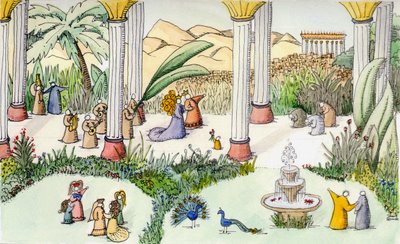

She did these back in her college days, a "Women of the Bible" series for a class project.
Okay, so I'm biased, but don't these take you into Scripture in a uniquely edifiying and imaginative way? Not that I'm fishing for compliments or anything...


Four Part Fugue
While riding home in the van this afternoon we had a cassette of old hymns playing, one child singing along, one child singing a completely different song, one child talking at warp speed about an unknown subject, and another child crying for his feeding. Steve and I actually laughed at all this! What a joy to have a van full of such unique (and noisy) individuals.
Steve's remark was that our family is like one of Bach's fugues: Several complex layers of individual melodies overlapping and playing at the same time. But instead of jumbled chaos, they work together with a synergy that produces a more beautiful song than the separate pieces.
Steve's remark was that our family is like one of Bach's fugues: Several complex layers of individual melodies overlapping and playing at the same time. But instead of jumbled chaos, they work together with a synergy that produces a more beautiful song than the separate pieces.
7.25.2006
Worldview
"Your [thinking] ought not to be: 'This is America. I get to do what I want. And you can't find a Bible verse to make me stop.' That's not Christian worldview thinking. You need to think and weigh why you do what you do in everything." - Doug Wilson
Military info
Check out the military history podcast way down on the sidebar. You have to listen to get all the info - about 11 minutes, I think. The latest on Clinton's Haiti action, was actually very informative on military forces in general, and special forces in particular. Great stuff for this mostly-military illiterate guy.
He notes that there are currently over 1 million soldiers actively stationed in the United States. Seems like a few more than our founding fathers would have countenanced, wouldn't you say? Or am I missing something?
He notes that there are currently over 1 million soldiers actively stationed in the United States. Seems like a few more than our founding fathers would have countenanced, wouldn't you say? Or am I missing something?
RCA homosexuality dialogue - my 2 cents
Here's a post of mine to an RCA email list.
I'm responding to this - it will be helpful to read it first.
Having spoken briefly with Dr. Stapert at GS, I appreciate his clarity in presenting and mediating this dialogue. He does a good job reminding us that this is OUR problem, not something he's going to solve for us.
However, I believe it is misleading for Dr. Stapert to say the dialogue has 86%endorsement from GS. There was a significant minority (something like 35-45%) that voted to end the dialogue, and then a GS majority voted against its own theology committee's recommendation to keep the process as it is - to not set boundaries on the discussion. But then, with nothing on the floor, GS then voted not to set boundaries to the discussion. So we were schizophrenic, not to mention unfaithful to Scripture. God's word does not allow dialogue within the church over a clear sin (1 Cor 5:1-2, 12-13; Rev 2:20), and the context and players in this dialogue reveal that we ARE questioning, or reconsidering, the sinfulness of homosexual practice, even if liberals and moderates protest that we are not doing so.
While the stated purpose of dialogue is rather benign, it obfuscates the division in the body over how to read Scripture and reduces the whole thing to a let's-all-understand-each-other thing, when there are serious theological divides.
The phrase "miserable 30-year history": who is responsible for causing anxious conflicts and relationships in the last 30 years over this issue? How does the verse go: "warn a contentious brother once or twice - then have nothing to do with him..." (Titus 3:10). It does not say to make sure you have a healthy dialogue process. We are letting the world's standard of being nice trump the Bible's standard of righteousness and purity in the church.
It's interesting to me that we have a psychologist facilitating this dialogue, instead of a theologian. Lowering anxiety seems to be the main theme of the dialogue. As if after the Kansfield trial, the RCA leadership has to say to everybody, "All right, now settle down!" There appears to be a very patronizing assumption currently held among RCA leadership, that everybody's emotions are running too high right now for any reasonable discourse to take place.
I'm not "afraid of dialogue," as some argue. It does not follow logically that if you are against something you must be afraid of it. As a result of this dialogue, I see more liberal slide occuring among conservatives and moderates, and not as much winning of moderates to the Biblical view. The moderates already HAVE a Biblical view of the issue, for the most part, but they aren't willing to discipline those opposing Scripture. A dialogue process isn't likely to get them to see the need for that discipline.
Finally, please try not to get used to (i.e., lower your anxiety over) something that isn't right, just because it is going to happen anyway.
Following Messiah Jesus,
Pastor Steve Hemmeke
7.24.2006
Field Trip!
 A call for help went out among the Hemmeke brothers to get the straw baled on the farm a few weeks ago. Steve tossed a few bales into the mow (ok, an elevator helped a lot), and the kids and I cheered the workers on.
Owen helped Steve and Grandma stack straw bales, but it was short lived as the baler broke down. You have to understand, that's like predicting snow in January. Steve's brother Ken tried all his mechanical wizardry to make it work again, but to no avail.
 Grace pretended to direct the crew on Aunt Emily's cell phone. Or was she ordering pizza?

Isaiah was happy to just revel in all the John Deere glory around him. And he got a candy bar to boot when we visited some relatives who live across the field. You can pick just about any field in the area and we have relatives living by it!
 Here's another of Steve's brothers - Cal - with Owen on the tractor "bringing in the sheaves."

And the parting shot of the 5.9 of us - no matter how many bales I tossed, that baby wasn't coming out!!
And what's WORSHIP about?
Al Mohler quotes A.W. Tozer:
"It is now common practice in most evangelical churches to offer the people, especially the young people, a maximum of entertainment and a minimum of serious instruction. It is scarcely possible in most places to get anyone to attend the meeting where the only attraction is God. One can only conclude that God's professed children are bored with Him for they must be wooed to meeting with a stick of striped candy in the form of religious movies, games and refreshments."
Al Mohler continues: "The striped candy technique has so fully integrated into our present religious thinking that it is simply taken for granted.... Any objection... is met with the triumphant reply, 'But we are winning them.' And winning them to what? To true discipleship? To cross-carrying? To self-denial? To separation from the world? To crucifixion of the flesh? To holy living? To nobility of character? To a despising of the world's treasures? To hard self-discipline? To love for God? To total commitment to Christ?"
Subscribe to:
Posts (Atom)