I began a sermon series on the book of Samuel yesterday, going through 2:11 to start. Here's the outline:
I. 1-8: Hannah’s barrenness
II. 9-11: Hannah’s prayer
III. 12-18: Eli and Hannah
IV. 1:19-23: Birth of Samuel
III. 1:24-28: Eli and Hannah again
II. 2:1-10: Hannah’s song
I. 2:11: Hannah’s fruit
Notice the symmetry. It's called a chiasm, in the scholarly world. I prefer the "sandwich theory," because it's what's in the middle that defines a sandwich - so also it is what is in the middle section that is key. Here it is God remembering Hannah and the birth of Samuel.
Some extra stuff that didn't make it into the (already too long!) sermon:
1. The text hints that Eli is less than faithful in his sitting in the temple and assuming Hannah is drunk. The language in verse 12 highlights this. The word used for Hannah praying is "intercede," "mediate," "arbitrate." This is what Eli was supposed to be doing. But what is he doing? He is watching Hannah! And Hannah is interceding "before the face of Yahweh" which is the exact language for what a priest was supposed to do. I suppose this makes the argument for some liberal friends that women ought to be allowed to be ministers. But I'd say instead that it foreshadows Hannah's child (she prays for a boy), who will intercede that way, and that it contrasts with what Eli should be doing.
2. The effect of prayer on our spiritual condition: verse 18. After she prays and is blessed by the not-utterly-corrupt Eli, she eats and is not sad. She is already comforted, even before knowing if she will receive what she asked for. This is like the Psalms, where the Psalmist is in distress, prays, and then gives thanks right away. Nothing has happened yet - except the most important thing of pouring out one's heart before Yahweh.
10.16.2006


10.11.2006
Whatsa covenant?
"Covenants are, at bottom, relationships. Covenants are not doctrinal abstractions. Covenant is not a mere word that we use to distinguish ourselves from other denominational traditions. Covenants are structured in the very way that God created the world, and in the way He recreated the world in Jesus Christ. Simply put, you are never alone. Everywhere you go, in everything you do, you are always in relationship."
- Douglas Wilson
- Douglas Wilson
Too Tempting

There's an article here about William and Mary being required by the NCAA to change it's logo because the presence of the two feathers was ruled "hostile and abusive." (more here) They are still allowed to have use their nickname "Tribe."
Hmmmm.... after having done 3 school logos (which required the use of feathers), it's fun to think about doing one for W&M! But I don't think I want to put my feet by that fire. However, I am very curious to see what they'll come up with! It will be difficult to come up with any logo for a name like Tribe that is less "offensive" than 2 simple feathers.
If we're not careful, our society will require us all to use 50% grey in an ambiguous blob-shape to represent EVERYTHING (but then I suppose the evolutionists would be offended by the use of such a shape!)
Persecution continues
"On Monday Somali jihadists declared holy war against Horn of Africa rival Ethiopia. But at least 48 hours before the pronouncement, church leaders in southwestern Ethiopia already had discovered they were at war with radical Islamists.... Within a matter of two days, they had burned over 350 homes belonging to Christians, killed 31 Christians, and took dozens as hostages, according to local church leaders. Muslim attackers burned one Catholic church, one Orthodox church, and and three evangelical churches." - World Magazine
Be aware of persecution against Christians today. Get the full story here.
Be aware of persecution against Christians today. Get the full story here.
10.10.2006
Jehu and Armageddon
Well, having mentioned Left Behind in my first sermon, and had interesting responses, I figured, "Why not more?"
2 Kings 9 unfolds Jehu's ascension to the throne by killing the kings of Israel and Judah, who were allied together in wickedness. I was startled to find several allusions to the book of Revelation here. (More accurately, it is the other way around: Revelation refers to this chapter.)
Elisha's servant anoints Jehu king, proclaiming that he "may avenge the blood of My servants the prophets, and the blood of all the servants of Yahweh, at the hand of Jezebel" (vs7). Rev 6:10; 18:20,24; 19:2 for similar lingo. We find the sorceries of Jezebel in 2 Kings 9:22 and in Rev 2:20; 9:21.
But perhaps most intersting the Left Behind fans would be the Armageddon connection in 2 Kings 9:27. The king of Judah is wounded by Jehu and flees to Megiddo and dies there. Revelation 16:16 says this is where the kings of the earth will gather together to fight against the Lamb at the end (Armageddon is Hebrew for Megiddo Mountain). And sure enough - here are two kings allied together, and Jehu comes charging in destroying them to avenge the blood of the prophets killed under their reign.
The point? The history of God's people as found in the Bible helps us know how God acts today and will act in the future as well. Because God acts consistently with His world. Know the family history of God's people, so you will know who God is and how He deals with His world. Those who harm His people will be punished; those who claim allegiance to Him may suffer now, but will be vindicated.
2 Kings 9 unfolds Jehu's ascension to the throne by killing the kings of Israel and Judah, who were allied together in wickedness. I was startled to find several allusions to the book of Revelation here. (More accurately, it is the other way around: Revelation refers to this chapter.)
Elisha's servant anoints Jehu king, proclaiming that he "may avenge the blood of My servants the prophets, and the blood of all the servants of Yahweh, at the hand of Jezebel" (vs7). Rev 6:10; 18:20,24; 19:2 for similar lingo. We find the sorceries of Jezebel in 2 Kings 9:22 and in Rev 2:20; 9:21.
But perhaps most intersting the Left Behind fans would be the Armageddon connection in 2 Kings 9:27. The king of Judah is wounded by Jehu and flees to Megiddo and dies there. Revelation 16:16 says this is where the kings of the earth will gather together to fight against the Lamb at the end (Armageddon is Hebrew for Megiddo Mountain). And sure enough - here are two kings allied together, and Jehu comes charging in destroying them to avenge the blood of the prophets killed under their reign.
The point? The history of God's people as found in the Bible helps us know how God acts today and will act in the future as well. Because God acts consistently with His world. Know the family history of God's people, so you will know who God is and how He deals with His world. Those who harm His people will be punished; those who claim allegiance to Him may suffer now, but will be vindicated.
10.09.2006
Two good quotes
"We are a generation that is more interested in 'how to' than 'for whom and to whom.' Also, we have emphasized our relationship with God in a way that can't carry the weight of God's holiness. Of course, we could equally err by emphasizing God's transcendence and differentness..... Our humanizing of God usually means that we also minimize His holiness."
Pg 150-151.
"'What works?' reveals our theology, our view of God. Doesn't this question suggest that we think God is a celestial genie, who makes everything better? But when we really know God, we worship and love him when our lives are comfortable and when they are difficult. And doesn't 'What works?' focus on ourselves rather than God?.... What's missing is an awareness... that Jesus is the reigning King."
Pg 156
Political Sigh of Relief
I'm thanking God today that my government representatives here in Virginia are closer to my own understanding of how government should function than they were in Michigan. Back in Michigan, some very liberal US senators are entrenched, though more locally we had good representation (liberal Detroit, conservative west side, the rest a bit of a mix). Here in VA, while I'm not versed in the regional landscape yet, and don't know all the details of each legislator's platform, still, except for the state governor, Tim Kaine, everybody else is on the right side of the aisle (pun intended), from US senators George Allen and John Warner to the US House rep, Jo Ann Davis, to the Virginia state delegate Melanie Rapp and senator Martin Williams. And while I'm increasingly frustrated with that party, I think it's genuinely better than the only politically viable alternative.
Still, I'm considering tossing my vote to a 3rd party. While it takes a vote from a real contender, it also sends a message to that contender of where their support is coming from - further down the political spectrum to the right, not to the center.
Still, I'm considering tossing my vote to a 3rd party. While it takes a vote from a real contender, it also sends a message to that contender of where their support is coming from - further down the political spectrum to the right, not to the center.
A golden parenting moment
So we're slowly reading through the Bible in our family devotions. The kids are small, so I do a lot of paraphrasing and editing on the fly (just can't read some parts yet!).
Well, we got to Sodom and Gomorrah, and I was plowing through and got wrapped up a bit in sternly applying Lot's slow obedience and the terrible result (mostly to Owen!). Then Isaiah needed some attention, so I had to put the book down for a minute. When I got back, I finished the story. Grace looked at me, and said, "But dad, you forgot the part about Lot's wife!" Sure enough, I had. But how did Grace know about her in the first place? I thought this was their first exposure to the story, but lo and behold, she knows it so well she's correcting ME! I was giddy about it the rest of the night - "our kids are learning"... surprise, surprise.
Oh, trust me, there are plenty of the other moments, where you're sure it's all going over their heads, too. But be encouraged - it ain't so.
Well, we got to Sodom and Gomorrah, and I was plowing through and got wrapped up a bit in sternly applying Lot's slow obedience and the terrible result (mostly to Owen!). Then Isaiah needed some attention, so I had to put the book down for a minute. When I got back, I finished the story. Grace looked at me, and said, "But dad, you forgot the part about Lot's wife!" Sure enough, I had. But how did Grace know about her in the first place? I thought this was their first exposure to the story, but lo and behold, she knows it so well she's correcting ME! I was giddy about it the rest of the night - "our kids are learning"... surprise, surprise.
Oh, trust me, there are plenty of the other moments, where you're sure it's all going over their heads, too. But be encouraged - it ain't so.
10.08.2006
Baptism and history

Had the privilege of baptizing a congregation member at the historic Sir Christopher Wren building, on the campus of William and Mary in Williamsburg today. This is the oldest college building in the USA (built in 1690s). Thomas Jefferson, James Monroe and others went to school here. It was chartered by the Dutch William of Orange and his wife Mary, who were then king and queen of England.
The child's grandfather spoke of his family's history 20 generations back, of how his son was baptized in the same place 26 years ago, and of how we must think of ourselves and our families across many generations, and not isolated from our past and future. What a great setting for such a theme! What a rich history we inherit, not just in our own families, but as Christians baptized into a family which has served God faithfully for millenia. How well do we know our family history?
Feeling Loopy
This week the kids and I had a "ball" doing what turned into to a family project. We looped cotton potholder loops together into on l-o-n-g chain, with the intent of knitting it into a rug.
The final loopy ball was immense, nearly the size of our baby!

We never did get a final count on how many loops we chained together, but I did weigh the final ball. Any guesses?

This was a great project to do with young children: cheap and easy to do; kids could spread out all over the floor, making their own chains to be looped onto the master chain; and it kept everyone very well occupied and entertained. They made jump ropes, queen's necklaces, prison chains, snakes and more! The only drawback was when someone wedged a potholder loom onto their head (after a few tears and fears that they'd have to live that way forever, we got it off with no harm done). But neat freaks be warned: this project leaves a ton of rainbow colored lint everywhere! Keep the vacuum handy.
Knitting something so CHUNKY on such fat needles was a challenge - I could only do a few rows at a time because my deltoids got sore! Grace and Owen took turns trying their hand at knitting, too. It was easy for them to learn with large needles and yarn. The final rug knitted up to be 3x2' in size. It's super squishy and such a delight to walk on. Almost makes me want to stand in front of the sink and wash dishes all day. Pics to come.
The final loopy ball was immense, nearly the size of our baby!

We never did get a final count on how many loops we chained together, but I did weigh the final ball. Any guesses?

This was a great project to do with young children: cheap and easy to do; kids could spread out all over the floor, making their own chains to be looped onto the master chain; and it kept everyone very well occupied and entertained. They made jump ropes, queen's necklaces, prison chains, snakes and more! The only drawback was when someone wedged a potholder loom onto their head (after a few tears and fears that they'd have to live that way forever, we got it off with no harm done). But neat freaks be warned: this project leaves a ton of rainbow colored lint everywhere! Keep the vacuum handy.
Knitting something so CHUNKY on such fat needles was a challenge - I could only do a few rows at a time because my deltoids got sore! Grace and Owen took turns trying their hand at knitting, too. It was easy for them to learn with large needles and yarn. The final rug knitted up to be 3x2' in size. It's super squishy and such a delight to walk on. Almost makes me want to stand in front of the sink and wash dishes all day. Pics to come.
Zachariah is Baptised!
On Sunday, October 1 our baby Zach was baptised. Steve performed the baptism after being installed as pastor for our new congregation. This one will go down in our memory as the only child who was baptised under a disco ball (worship services are held at a banquet facility). Our other children watched; Owen even had to rub Zach's head to make sure it was really wet! Steve's mom and brother Cal visited for the weekend and were able to worship with us.

We love fat, happy babies!
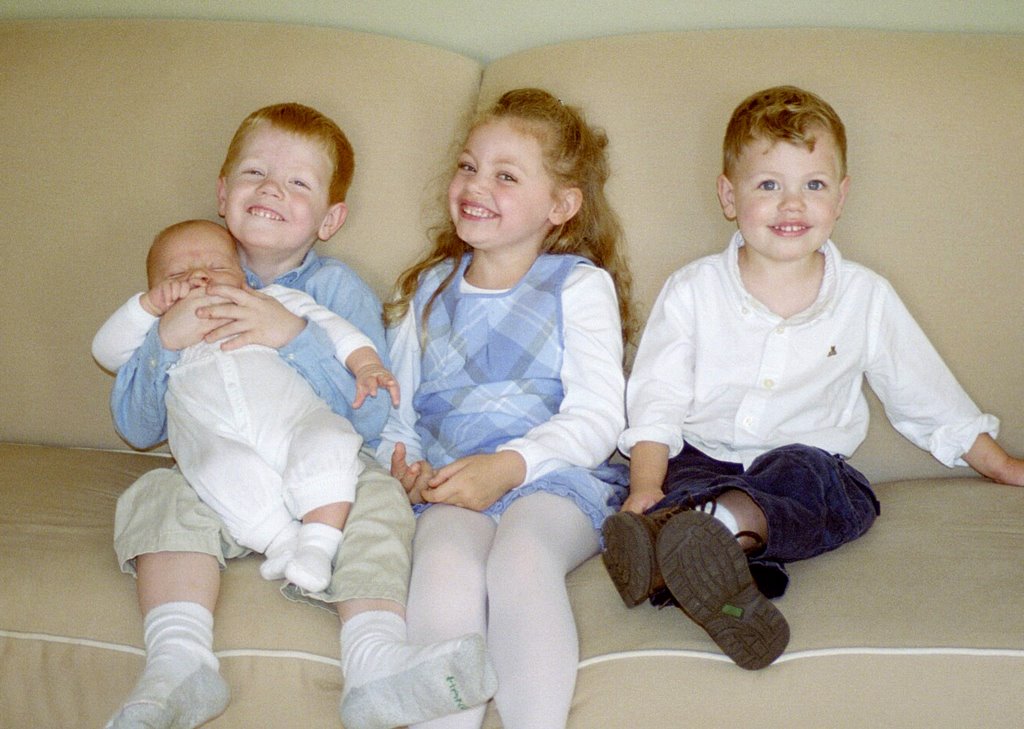
Zach, Owen, Grace & Isaiah
10.07.2006
10.06.2006

The outward covenant
The next Tabletalk article (October issue) is on the history of the covenant (pg 8-11, and is also quite good. It seems to turn into a brief against Federal Vision people, though. Here is the end:
"According to them [Fed Vis guys], every baptized person is elect and united to Christ through baptism, but this election and union can be forfeited through faithlessness."
I haven't read many FV guys - mainly just one. But I would agree with the above quote if the words elect and election were removed. We are baptized into union with Christ, but can be broken off if we don't bear fruit (John 15). This doesn't mean we were saved or elect, just part of the visible church for a while. This is probably is a bit more "high view of sacraments" than most Reformed people are comfy with - majority would say baptism is a sign of union with Christ, not that baptism actually does that. The sticky point is that we don't know who is elect, and God has called us to act this way, so by faith we ought to believe what He says in His word about the baptized being buried with Him in baptism, unless their fruit later in life shows otherwise.
Ironically, the same article, a column earlier, summarizes this quite well as it lays out Caspar Olevianus' position (author of Heidelberg Catechism):
"Since only God knows who is elect... the covenant of grace... can be said to be with all the baptized. Therefore we baptize on the basis of the divine command and promise, and we regard covenant children (before profession of faith) and all who make a credible profession of faith as Christians until they prove otherwise. Those who are in the covenant only in this broader sense or externally, do receive some of the benefits of the covenant (Heb 6:4-6), but they do not receive what Olevian called the 'substnace of the covenant:' justification and sanctification. Only those who are elect actually appropriate, by grace alone, through faith alone, the 'double benefit' of the covenant of grace."
"According to them [Fed Vis guys], every baptized person is elect and united to Christ through baptism, but this election and union can be forfeited through faithlessness."
I haven't read many FV guys - mainly just one. But I would agree with the above quote if the words elect and election were removed. We are baptized into union with Christ, but can be broken off if we don't bear fruit (John 15). This doesn't mean we were saved or elect, just part of the visible church for a while. This is probably is a bit more "high view of sacraments" than most Reformed people are comfy with - majority would say baptism is a sign of union with Christ, not that baptism actually does that. The sticky point is that we don't know who is elect, and God has called us to act this way, so by faith we ought to believe what He says in His word about the baptized being buried with Him in baptism, unless their fruit later in life shows otherwise.
Ironically, the same article, a column earlier, summarizes this quite well as it lays out Caspar Olevianus' position (author of Heidelberg Catechism):
"Since only God knows who is elect... the covenant of grace... can be said to be with all the baptized. Therefore we baptize on the basis of the divine command and promise, and we regard covenant children (before profession of faith) and all who make a credible profession of faith as Christians until they prove otherwise. Those who are in the covenant only in this broader sense or externally, do receive some of the benefits of the covenant (Heb 6:4-6), but they do not receive what Olevian called the 'substnace of the covenant:' justification and sanctification. Only those who are elect actually appropriate, by grace alone, through faith alone, the 'double benefit' of the covenant of grace."
What about faith?
Tabletalk for October is looking at Covenant Theology, and has been really good.
Sproul, Sr. says:
"All covenants that God makes with creatures are gracious in the sense that He is not obligated to make any promises to His creatures."
So even in the "covenant of works," before any sin was present, God was gracious to us.
Sproul then goes on to say the distinction between covenants before and after sin is important, though, because we need to be assured that God will accept/forgive us even after we have sinned and broken His commands. Amen, I say.
He then defends the imputation of Christ's obedience to our account, so that God CAN accept us. Again, Amen and Amen, I say.
But what is missing in all of it is faith. It is faith that kept Adam and Eve obedient as long as it did, before they ate the fruit. Only when Eve believed the snake instead of God did she disobey. We miss the crucial role faith plays in obedience when we focus so hard on a covenant of works - "do this and live." By faith, the heroes of faith conquered kingdoms, etc. Not by how hard they prayed, how little they slept, how dour their expressions, how sad they were when they confessed, how efficient they were, how stoically they held up against temptation, ultimately. No, the crucial element is faith. Obedience flows out of faith. Without faith it is impossible to please God.
This is important for today because we can rely on our own efforts overmuch in our sanctification. If only our family worship/devotions are a little longer, if only I my standards for behavior for our children were a little higher, then God would accept me (or at least like me more).
It is also important because without it we can see Jesus' obedience for us as one of employee (the Son) for employer (the Father), instead of what it is - love and faith flowing into ready submission. If we're not careful, we end up imposing our ungracious legalism onto the Trinity Himself, distorting the image of God we are supposed to reflect into the world.
Sproul, Sr. says:
"All covenants that God makes with creatures are gracious in the sense that He is not obligated to make any promises to His creatures."
So even in the "covenant of works," before any sin was present, God was gracious to us.
Sproul then goes on to say the distinction between covenants before and after sin is important, though, because we need to be assured that God will accept/forgive us even after we have sinned and broken His commands. Amen, I say.
He then defends the imputation of Christ's obedience to our account, so that God CAN accept us. Again, Amen and Amen, I say.
But what is missing in all of it is faith. It is faith that kept Adam and Eve obedient as long as it did, before they ate the fruit. Only when Eve believed the snake instead of God did she disobey. We miss the crucial role faith plays in obedience when we focus so hard on a covenant of works - "do this and live." By faith, the heroes of faith conquered kingdoms, etc. Not by how hard they prayed, how little they slept, how dour their expressions, how sad they were when they confessed, how efficient they were, how stoically they held up against temptation, ultimately. No, the crucial element is faith. Obedience flows out of faith. Without faith it is impossible to please God.
This is important for today because we can rely on our own efforts overmuch in our sanctification. If only our family worship/devotions are a little longer, if only I my standards for behavior for our children were a little higher, then God would accept me (or at least like me more).
It is also important because without it we can see Jesus' obedience for us as one of employee (the Son) for employer (the Father), instead of what it is - love and faith flowing into ready submission. If we're not careful, we end up imposing our ungracious legalism onto the Trinity Himself, distorting the image of God we are supposed to reflect into the world.
Subscribe to:
Posts (Atom)