9.11.2018

Classical Me, Classical Thee

Classical Me, Classical Thee: Squander Not Thine EducationClassical Me, Classical Thee: Squander Not Thine Education by Rebekah Merkle

My rating: 4 of 5 stars


A quick 100 pages written to classical school students to point out the benefits of such an education, and to call for appreciating and not squandering such a gift.

Merkle does a decent job speaking to a high school audience, with little gimmicks or patronizing, making the case for logic, rhetoric, Latin and more. I’m not sure 6-7 chapters were needed each on a different topic, but the basic point was a good one: you’ve been given a gift. Don’t squander it like the man given 1 talent who buried it in the ground.


View all my reviews

9.10.2018

Augustine on church music; Tripp on midlife

Quotes from my reading:

"Midlife is a war between our dreams and reality, and too often, people, families, and churches are its casualties."
Lost in the Middle, Paul Tripp, pg 140.


About "ceremonies which are found different in different countires... we should not only refrain from finding fault with them, but even recommend them by our approval and imitation, unless restrained by fear of doing greater harm than good by this course....  as in the singing of hymns and psalms...  so useful for inducing a devotional frame of mind and inflaming the strength of love to God, there is diversity of usage."
Letters of Augustine, letter 55, Nicene and Post-Nicene Fathers, vol. 1, page 314.

Orthdoxy

OrthodoxyOrthodoxy by G.K. Chesterton

My rating: 4 of 5 stars


A grand apologetic work in which Chesterton shows the madness of modern atheist thought, displays the wonder of the mundane world, and glories in the ancient novelty of orthodoxy.

Ancient novelty, you say? This is my own phrase for Chesterton’s self-described journey to faith. He came to orthodox Christianity thinking it was a brand new thing, only to discover it had been there all along. Like sailing the ocean, coming to land and thinking it’s a new discovery, only to find out you’ve hit Long Island.

Chesterton calls for a loyalty to the world as God made it. We need to reject the pessimistic hatred of life and suicide toward which modernity inevitably drags us. Do we critique things and people because we love them or because we love hurting them from a resentment inside?

Part of that loyalty is maintaining a wonder at it all. It isn’t some law of necessity that turns eggs into chickens – it is magical. God calls to the sun every morning: “Do it again!” We get tired of this because we are old and stale, while God remains full of vitality. This wonder leads us to respect creational boundaries God built in to it.

Chesterton’s literary knowledge and references are vast, and I hardly get half of them. His writing style is quite meandering and indirect. It isn’t for everyone, but his ideas are an essential and hearty tonic for the orthodox, and an effective antidote against the atheistic and materialistic thought that continues to prevail today.


View all my reviews

9.04.2018

Reset

Reset: Living a Grace-Paced Life in a Burnout CultureReset: Living a Grace-Paced Life in a Burnout Culture by David P. Murray

My rating: 5 of 5 stars


An immensely helpful book specifically for burned out, middle-aged pastors, but kept general enough to be useful to anyone stressed out. There is a companion book for women, called Refresh.

Don’t be fooled by the gimmicky-appearing alliteration on the surface (10 chapters starting with “re”) – there is a great deal of wisdom here. The simple structure and shorter chapters is an essential format for the burned out, so there’s a method to Murray’s marketeering.

The foundation of grace at the beginning is key, and distinguishes this book from others addressing the same topic. The keynote is that grace provides space to slow down, take stock, and make wiser decisions about your priorities, health, time, etc.

And there are lots of zingers throughout:

“What I do instead of sleep shines a spotlight on my idols” (pg. 55).

[Muting phone notifications] “produces a totally different mindset and mind depth than the one that’s sub-consciously waiting for the next beep or ding” (93).

“It’s not ‘Rest when you have nothing to do,’ but ‘Rest because we will never be done.’” (101).

Murray tackles root issues, like letting your work or past failures be your identity, instead of Christ and His grace. And he does so in very practical ways, touching you where you live your life.

Highly recommended.


View all my reviews

9.03.2018

The Doctrine of the Covenant

The Main Points of the Doctrine of the CovenantThe Main Points of the Doctrine of the Covenant by Klaas Schilder

My rating: 4 of 5 stars


A speech by Klaas Schilder, 1944.
This was my first foray into Dutch theologian Klaas Schilder’s writings, and it will not be the last.

The author’s name has come up in recent theological controversies, and now I know why. Schilder emphasized the outward or objective covenant, which is formally marked by baptism. And his accent is on God speaking His promises and commands to everyone in that covenant, not just the elect whom we cannot know with certainty.

The setting is quite polemical. Schilder is obviously arguing against another side in a debate. The other side is saying that if we talk about conditions in the covenant of grace, we make it a legalistic, works-based thing, which Paul was talking about and rejecting in Galatians. Schilder rejects this:

“If it is true that we are letting the covenant become a preaching of laws or a theory of morals, then [their] allegation is entirely just. Both groups are hollowing out the covenant: those who preach the promise and shove the demand into the background, and those who because of the demand neglect the sweet music of the promise; both have slipped away from the covenant” (pg 10).

We must “let God speak in a conditional manner” (12).

Schilder asserts at the same time, the confessional doctrines of grace and election. “Any good that comes from me is God’s gift and is from Him alone! Yet we must speak of conditions: I will not receive it if I do not comply with the demand – faith is the first demand” (13).

This was only a short speech. I plan to tackle Christ and Culture next.

The only publishing information in the hard copy is as follows:
Printed in Canada.
Translated by T. vanLaar, 1992


View all my reviews

Thinking through Anxiety

Thinking Through Anxiety: A Brief Christian LookThinking Through Anxiety: A Brief Christian Look by J. Ryan Davidson
My rating: 3 of 5 stars

In this short booklet, the author gives a solidly Biblical look at a neglected issue.
Davidson considers how the Gospel, the ordinary means of grace, Sabbath, and our thinking patterns affect our worries. I especially appreciated the "back-burner" idea, of how to handle unhelpful thoughts that will not go away.


View all my reviews

8.21.2018

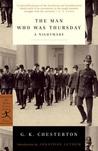
The Man Who Was Thursday: A Nightmare

The Man Who Was Thursday: A NightmareThe Man Who Was Thursday: A Nightmare by G.K. Chesterton

My rating: 4 of 5 stars


In this short, learned yet witty and entertaining story, Chesterton shows us the way of the happy warrior. He has the courage to stand and fight and die in the face of evil. But he also has the faith and optimism not to believe the world will be lost. Others may believe that the world is overrun, but not the man who was Thursday.

The story is about the transition from undercover darkness to the open sunlight. From a concern for a petty, paltry and harmless anarchist, to a focus on the Face larger than life that envelopes the world in His grace. In a word: things aren’t as bad as they look, or as we may dream them to be.

This is a book to savor. Don’t read just for the plot. Chesterton knew how to craft words. Read slowly enough to drink in all his hints, allusions, biblical references and so on.

The dreadful dream turns delightful in the end.


View all my reviews

8.20.2018

Peace, Work, and a Glorious Dominion

A communion exhortation from Isaiah 26:12-13
   "LORD, You will establish peace for us,
    For You have also done all our works in us.
    13      O LORD our God, masters besides You
    Have had dominion over us;
    But by You only we make mention of Your name."


These are important gospel words from the middle of an ancient scroll of Isaiah the prophet.  God HAS established peace for us, at the cross of Jesus Christ.  We remember that act here.  When we urge ourselves to good works for the Lord, we remember that it is God who is at work in us to will and to do for His good pleasure (Philippians 2:13).  We remember that we have had other masters we have served before our conversion, or that we have tried to serve in our sinful nature.  But their tables were not so fair, their wages cannot compare with the gift of grace we receive here.

No, we name the name of Jesus Christ, the Lord and King and Sovereign of the world, and of our hearts.  We proclaim His death, and His resurrection here at this table.  His dominion is glorious.  He rules your personal life perfectly; He reigns over the nations with ease; they are a drop in the bucket to Him.


So come and welcome to the Lord Jesus Christ.  Take hold of Him.  Rely on Him alone as You receive His grace.

8/20/18

Add to Your Faith

A call to confess our sins from 2 Peter 1:5-11.

"giving all diligence, add to your faith virtue....
be even more diligent to make your call and election sure."


As we will see in the message, there is a kind of knowledge of JC that is barren and unfruitful.  As James says, there is an empty and dead pseudo-faith that doesn’t save anyone.  True faith adds to itself, virtue, knowledge, self-control, perseverance, godliness, kindness, and love.  True faith is diligent to repent, to act, to serve.  So work to make sure of your election. 

Many Calvinist Christians, zealous for the doctrines of grace, maintain a studied apathy to works and piety and any effort put forth in the Christian life.  That might imply we are trying to earn our salvation.  Well, it is easy to slip into that works righteousness mentality – we want to watch out for it, definitely.  But Scripture in many places urges us on to strive, to press on for the upward call.  Of course our calling and election are as sure as can be in heaven, in the book of life, from God’s decrees.  But we also have the call to work that out in our lives.

So let us confess times we have let down our guard, gotten lazy or casual about our purity, or our prayers or Scripture reading.  Times we have neglected to add virtue to our faith.

Let us confess our sins to God.

8/20/18

Murder Must Advertise

Murder Must Advertise  (Lord Peter Wimsey, #10)Murder Must Advertise by Dorothy L. Sayers
My rating: 3 of 5 stars

This was my first Sayers mystery about Lord Peter Wimsey.
It was an unusual murder mystery that seems to change stylistically with every chapter. It seemed Sayers was trying out her literary skills at describing different scenes in this story.

A major emphasis was showing the indirect cunning of Lord Peter as a detective. Maybe this is characteristic of all her novels.

It was interesting that Wimsey and the police were resolved to pursue the criminals to the top of the drug chain, even though they know the ringleaders will just be replaced anyway.


[Spoiler alert]
That ending! Was it right of Wimsey to let Tallboy be killed by the drug ring? He sees them out his office window and lets Tallboy go, knowing they will kill him. (Tallboy is the middle man in the office dealing drugs between the suppliers and the street.)? It was poetic justice, letting the bad guys he profited from kill him off. Axnd there was mercy there in sparing his posthumous reputation with his family. This ending is the classic murder mystery conundrum of pursuing official justice, which will always be incomplete or unjust in some ways, OR allowing justice outside of the law to run its course, which is truer and more proportional to the crime.


View all my reviews

8.15.2018

Through Gates of Splendor

Through Gates of SplendorThrough Gates of Splendor by Elisabeth Elliot

My rating: 5 of 5 stars


Elisabeth Eliot’s first memoir of her foray into the mission field recounts her husband’s and 4 fellow missionaries’ death at the hands of the native tribe they were trying to reach with the Gospel of Jesus Christ.

Written in 1956, within a year of the event, Eliot gives the background of each young couple feeling called to missions, heading to the field, learning the language, and much more. One was wondering if he was even called by God to be there in the first place.

The missionary zeal assumed by all was quite startling. Much has changed in the missions world in the last 60 years! Then it was a crusade to undertake for the Lord. Now we seem to worry more about paternalism and the side effects of Western interaction with isolated tribes than we do about their salvation. These missionaries had an innocent, clear goal to reach people for Christ. Yes, there were times a condescending attitude came through: those poor savages need the Lord. But they thought long and hard about why they viewed the tribes as savages, and it wasn’t because they didn’t have electricity. They considered carefully why they went to all the trouble they did. Was it the thrill of flying planes through the jungle? No, they truly sought to make contact and communicate so they could bring them the good news of Jesus Christ. Their excitement for the mission was evident, as was their single-minded focus on the mission.

And so much planning was needed! Eliot spends most of the book recounting preparations and plans. Half of that was the internal battle within each missionary, each wife, surrendering plans to the Lord, purifying motives, setting aside pride or haste. But the other half was the external logistics involved. Making a list of what to fly where, gathering supplies to get ready to clear a new landing strip, or build a new mission station. It reminded me of the coordinated effort that mission work requires. Several mission aviation ministries carry on this work today. While the random one-on-one evangelistic interaction has its place, most mission efforts involve a cultural exchange. The seeker comes into the church and observes a Christian culture different from his own. Or the missionary takes his technology and his Bible, things he’s gleaned from his own culture, and goes to learn a new language and live a new way.

Part of the story I didn’t know before was the 5 men’s decision to keep secret from their missions supervisors their efforts to contact the Aucas. When do you go it alone and when do you coordinate with supervisors? Perhaps their zeal took them too far in this case. We can certainly admire their courage to lay down their lives to reach others. Watch out for armchair, Monday morning quarterbacking, second guessing their decisions! But I’m sure there are important lessons missionaries are learning from Eliot and many others, too.

Elisabeth’s wife Jim wrote in his journal in college: “He is no fool who gives what he cannot keep to gain what he cannot lose.” This book is part of the testimony of these men’s willingness to risk all to bring Christ to the world. An important read for all believers in the Lord.


View all my reviews

Less Distraction

Turn off your phone's notifications!

I recently took a 2 week vacation, and thought to turn off my phone notifications.  This made a huge impact on me personally, and I’m not turning back.  Part of taking dominion of my time and schedule is not allowing my phone to distract me every few minutes with the latest email, Facebook notification, Instagram, messenger message, news item, or text.  Even when such social interaction is part of my work, I need to go to those messages on my time, so that I can maintain some rhythm in my study and writing, etc.

Tony Reinke has written on this: "12 Ways Your Phone is Changing You."
Check it out.

8.14.2018

The City of God

City of GodCity of God by Augustine of Hippo

My rating: 5 of 5 stars


Augustine’s wide-ranging apologetic work, The City of God, thoroughly refutes the Roman worldview and sets forth the Christian perspective as more reasonable and rewarding. As the city of Rome was sacked and the barbarians invaded, Augustine’s timely work propelled readers already questioning the invincibility of the Roman empire, to consider another option – the city of God.

The City of God is more detailed than I expected. He begins by tearing down the plausibility of the Roman gods. Piece by piece, he shows the contradictions in various myths and legends about them, using their own authorities as his sources. He does the same in the field of Philosophy. Augustine’s knowledge of Greek and Roman culture was vast. Modern apologists wondering how to “engage the culture” would do well to take Augustine as an example. He then lays out the Biblical story from Genesis to Revelation, emphasizing creation and the final judgment. He ends with a beautiful description of the beatific vision, contrasted with the punishment of the wicked.

Augustine is not without his flaws. He allows for the possibility of purgatory, and assumes that baptism automatically washes away original sin. It isn’t hard to see the trajectory toward the Roman Catholic sacramental system as a result. He also places too much emphasis on present day miracles as a reason to believe in the truth of Christianity. That one was a surprise to me – don’t hear that talked about much in connection with Augustine, but it’s right there in book 22, chapter 8. And he goes on for several pages about it.

He doesn’t come out and say this, but implied in Augustine’s overall structure is this thesis: the Christian story of God’s city is a better story than that of Rome. Besides being true where Rome’s story is full of holes and superstitions and outright lies, the city of God really will last forever. And the happiness that it brings far surpasses the happiness the Roman philosophers set before us for this world.


View all my reviews

8.13.2018

Hillbilly Elegy

Hillbilly Elegy: A Memoir of a Family and Culture in CrisisHillbilly Elegy: A Memoir of a Family and Culture in Crisis by J.D. Vance
My rating: 4 of 5 stars

JD Vance gives a personal, insightful and shocking account of the lifestyle of the poor. He moved from the culture of dependence to the culture of the elite – from living among welfare queens to being a responsible provider himself. Bridging these two worlds, Vance has a unique vantage point from which to better see each culture.

A key theme: stable homes are crucial. When mom has a revolving door of boyfriends, the stress on the children is massive. Sister had to be his stand-in mom, and Grandma had to save him from that nightmare and give a sufficiently stable environment for him to even pass high school.

There’s a lot of strong language in the book, so I don’t recommend it for younger readers. There are also a couple of spots with intense adult themes. I can’t decide if these were gratuitous or necessary to depict the crazy life Vance lived. His greatest source of stability was also his main source of vulgarity, it seems. This exponentially ramped up the shock factor, for me.

It was interesting how the cultural dynamic crossed ethnic lines. Vance made passing reference to inner city lifestyles being similar to his hillbilly culture, and I also noticed some mafia themes. We police our own – hillbilly justice has its own flavor that doesn’t wait on local law enforcement.

The appeal of this book (New York times bestseller) seems to be in the author’s straddling of the political spectrum. He asserts both that the poor make bad choices that result in their poverty, and that they are disadvantaged by their environment – family history, upbringing, etc. This is not a contradiction, much less competing political interests, but just two factors piled on top of each other. It raises the old nature/nurture question. Could Vance have “made it” without Grandma giving him a stable environment? It appears not. He had to make different choices than his hillbilly family made, however fond he was of them. Vance calls himself a conservative, but there is a more liberal underpinning to his memoir: we cannot make good choices without the proper environment and structure to enable them.

Then again, I’m not sure this is exclusively liberal. It is the libertarian, secular conservative who asserts self-autonomy, not the social conservative. Where Hillary Clinton argued that “It Takes a Village,” Rick Santorum said “It Takes a Family.” Vance is somewhere in between, but it takes more than just you, for sure. Rush Limbaugh may argue that “It Takes Myself,” pulling me up by my bootstraps, but not many are buying that, I think. Maybe that’s the appeal of the book. Vance moderates each end of the political spectrum. Liberals need to face the dire consequences of awful personal choices. Conservatives need to face the real uphill climb of negative upbringing and the expectations that shape that reality.

The note of personal responsibility and pride in providing for others appealed to my conservative side. The revolution in his psyche when he came home as a Marine and could give his family things, instead of always need to take from them - that's key.

I don’t know that subjecting yourself to the repeated f-bombs and other junk that Vance deals out in spades is worth this book, to get the valuable lesson that we need to make unselfish choices in our work and family life. Read with caution.


View all my reviews